
AFSPA or Human Rights Violation?
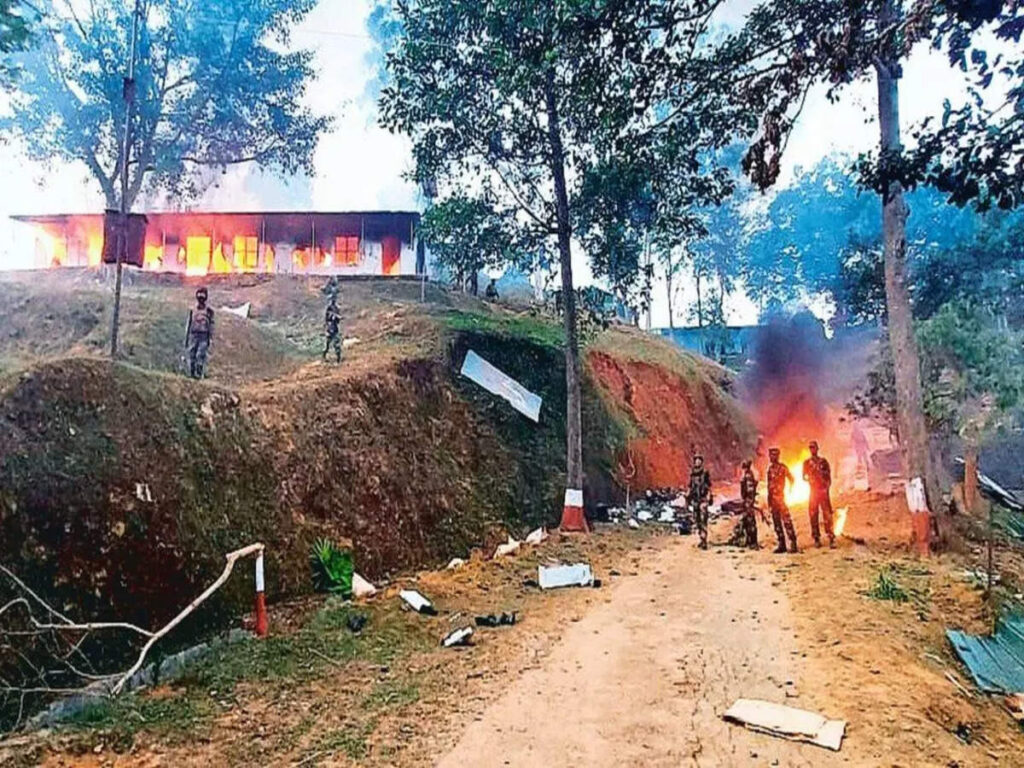
13 innocent killed in Nagaland
The mass killing of civilians in the name of Security (AFSPA) was not the first time happened in the northeastern state. Eyewitnesses claimed the first army planned an illegal encounter; later police tried to cover up their deed.
Earlier this Saturday, 13 innocent were alleged killed by Army’s 21 Para SF during a plotted encounter. Out of which, eight poor coal miners were from the Mon district of Nagaland, and five were from other villages who were killed while chasing gunshots sound. But as per the preliminary report submitted by Nagaland Police, the operation took place, post a confidential tip about insurgents’ movement, and our soldiers were trying to take bodies to the police station for further investigation. “ There was never any intention to hide what had happened…” police added.
Ground Report
People are scared of these violent acts. Because of soldiers negligence, villagers witnessed mass coffins buried as a mass graveyard. Folk couldn’t bear their emotion.
They cried their heart out, some hold two bodies, some hold one. The village turns into a necropolis. Nasty villagers took law and order into their hands, they bounced back to armed camps and tried to set them on fire. Huge violence and counter-attack are still going on.
The state government tried to seek help from the central against this controversial law to roll out. But, knocking Government door sounded inconvenient when the label of ‘Disturbed Area’ stood up. The context of insurgents activity is quite common in the northeastern part, so as to control such action, AFSPA (Armed Forces Special Powers Act, 1958) was introduced by the Parliament of India.
Decades ago, when this act commenced, it grants special power to Armed Forces (including the Army, the Air Force, and the central Paramilitary Forces, etc.) to maintain pubic order.
Central Reports on AFSPA
Reports have been submitted to the Supreme Court on fake encounters committed in the state of Manipur since 1979, which includes nearly 1,528 cases. If one goes through the reports on the number of innocent people killed, then one will notice that nowhere people in Manipur are safe. Especially the data shows that most young men are killed because they are suspected of being militants.
Admitting, some instances of civilian deaths at the hands of the security forces are the result of “genuine mistakes” by soldiers “in the heat of an operation,” the Manipuri activist pointed out that this does not apply to rapes as the government never admit such killings. The spiralling violence in areas it is in force. The “sweeping powers” vests in the hands of the armed forces and especially the protection it gives them from prosecution “encourages soldiers to kill, raid and rape,” the Manipuri activist argued, drawing attention to “grave human rights violations” that AFSPA has “enabled.”
Do AFSPA stimulate killings?
With reference to Disturbed Areas Act, 1976, once declared ‘disturbed’, the area has to maintain the status quo for a minimum of 3 months, which later can be extendable. Let’s know what precisely ‘special powers’ under Section 4 means;
(a) Power to use force, including opening fire, even to the extent of causing death if prohibitory orders banning assembly of five or more persons or carrying arms and weapons etc. are in force in the disturbed area;
(b) Power to destroy structures used as hid-outs, training camps or as a place from which attacks are or likely to be launched etc.;
(c) Power to arrest without warrant and to use force for the purpose;
(d) Power to enter and search premises without a warrant to make arrest or recovery of hostages, arms and ammunition and stolen property etc.
Sticking to this crucial note, AFSPA is a special law that can be enforced only in certain parts of the country where public order should biding “ the use of Armed forces in aid of Civil Power is necessary” as under Section 3. Currently, it is in force in Jammu & Kashmir; States of seven sisters includes Assam, Nagaland, Manipur (Excluding Imphal Municipal Council Area) and Changlang, Longding and Tirap districts, plus areas falling within the jurisdiction of eight police stations of Arunachal Pradesh bordering the state of Assam.
Repealing such laws
There have been committees in the past which were set up in 2004 to repeal the act like the Justice Jeevan Reddy Committee which was set up and the then PM Dr Manmohan Singh formally agreed to review the AFSPA after the killing of Thangjam Manorama Devi in the year 2004, it was a committee set-up with Justice Jeevan Reddy, a retired Supreme Court judge as its head to review Armed Forces Special Powers Act, 1958.
At present both the ruling party as well as the opposition party raised their voice to revoke AFSPA. They are appealing central government to maintain peace and harmony so set the stage back to normalcy.

Zeba Gouhar
Reporter